 ← Back to Resources
New York City's congestion pricing program, launched in January 2025, has generated results that even its cautious advocates find impressive. In its first year, over 71,500 fewer vehicles entered Manhattan's central business district each day — an 11% reduction. Traffic delays in the congestion zone fell by 25%. Holland Tunnel rush-hour delays dropped 65%. The program exceeded its revenue targets, generating $548 million in its first year, with that money earmarked for long-overdue transit improvements.
These are real gains. But a careful look at the data reveals a more complicated picture — one that points to the limits of pricing as a standalone congestion strategy, and to the complementary tools cities need to fully realise its promise.
What Congestion Pricing Does Well
Congestion pricing is, at its core, a demand management tool. By assigning a cost to driving in high-density urban zones, particularly during peak hours, it discourages discretionary car trips and incentivises mode shift to transit, cycling, or off-peak travel. The mechanism is economically rational and, when implemented well, demonstrably effective.
New York's experience confirms the theory. Vehicle volumes fell sharply. Bus speeds in the congestion zone improved. Subway ridership climbed toward post-pandemic highs. Air quality in Manhattan improved measurably, and notably, pollution improvements extended across the broader metro area, suggesting drivers were genuinely opting for alternative modes rather than simply rerouting. Cornell University researchers, studying the program's first-year air quality data, described the pollution reduction as exceeding outcomes seen in London and Stockholm after their own congestion charging programs.
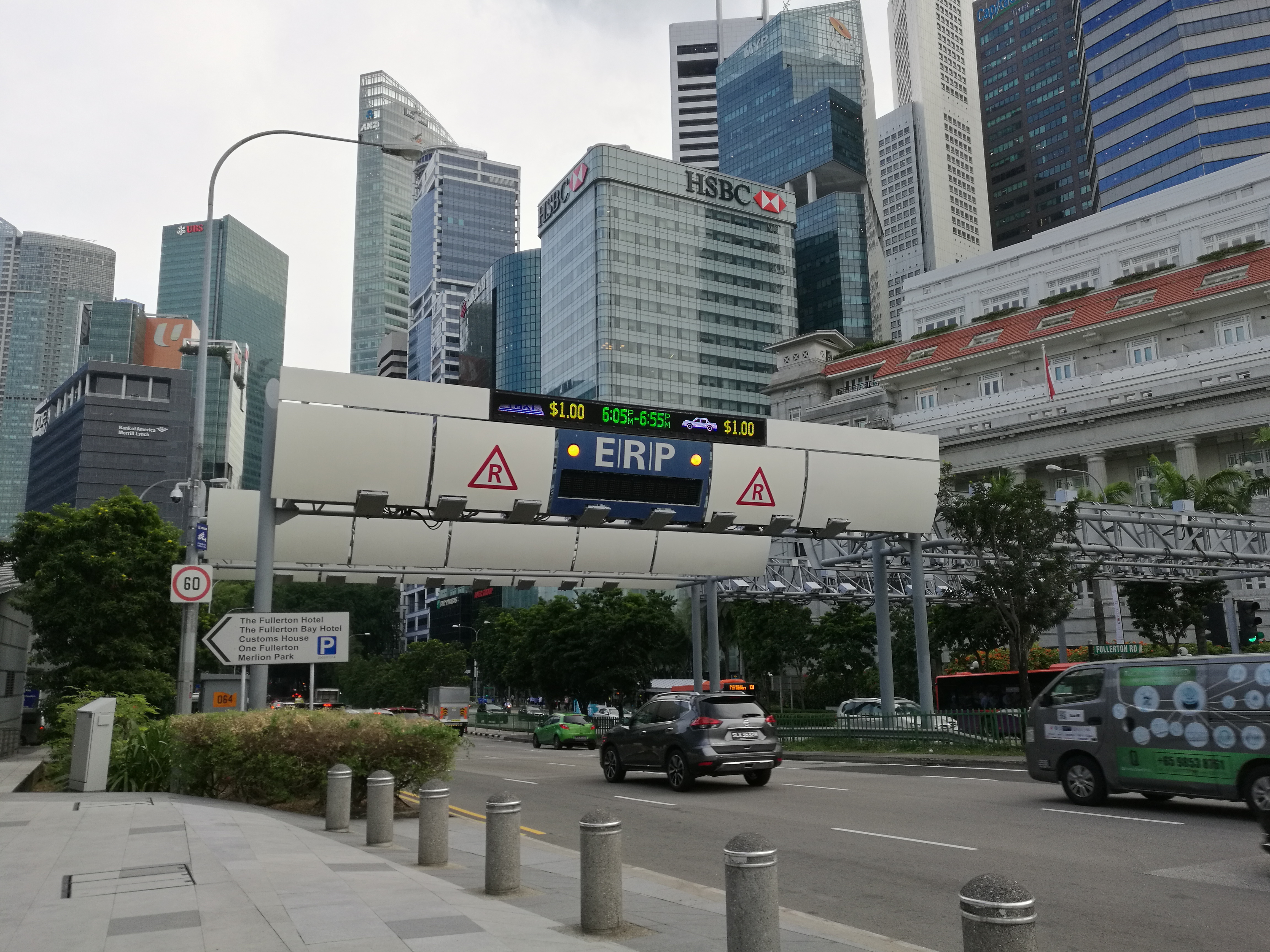
London's experience reinforces the case. Singapore, which has operated congestion pricing since 1975 and runs arguably the world's most sophisticated dynamic tolling system, has maintained consistently lower congestion levels than peer global cities — with drivers in Singapore losing just 20 hours to traffic delays in 2024, compared to 102 hours for New York drivers in the years before pricing was implemented.
Congestion pricing works as a demand lever. But demand management is only half the mobility equation. The other half is supply optimization — using the road capacity that exists more intelligently once the excess demand has been priced out.
The Limits Pricing Cannot Address
Congestion pricing changes the volume of vehicles entering a zone. It does not change how efficiently those remaining vehicles are managed once inside. A city that reduces vehicle volumes by 10% but continues to run its traffic signals on fixed timing plans is leaving significant capacity on the table. The vehicles that pay to enter the zone still queue at intersections that don't respond to real conditions. Corridors that could carry traffic efficiently continue to generate unnecessary delay.
New York's congestion zone contains thousands of intersections still governed by timing plans that predate the program. There's also the question of geographic displacement. While New York's data suggests that most mode shift has been genuine rather than rerouting-driven, some congestion relief inside the zone is inevitably offset by increased pressure on corridors and intersections outside it. Without adaptive signal control on those surrounding routes, the benefit to the broader network is diluted.
Adaptive Signal Control as the Complementary Layer
The most effective urban mobility strategies treat congestion pricing and adaptive signal optimization as complements, not alternatives. Pricing manages demand. Adaptive signals manage supply. Together, they produce outcomes neither achieves alone.
Pittsburgh's Surtrac system — without any pricing mechanism — achieved a 25% reduction in travel times through signal optimization alone. Los Angeles' adaptive signal network, managing over 4,800 signals, recovers 9.5 million driver hours annually. In both cases, the gains came purely from using existing road capacity more efficiently: giving green time where vehicles actually are, coordinating signals across corridors to create smooth flow, and eliminating the waste baked into fixed timing plans.
When pricing and optimization work together, the dynamics are mutually reinforcing. Reduced vehicle volumes give adaptive signal algorithms more headroom to create efficient flow patterns. Better signal coordination makes the experience of driving within a priced zone more acceptable to those who choose to pay, reducing political friction around the pricing mechanism. And the data generated by both systems provides a richer picture of network performance for long-term planning.
The Political Dimension
Congestion pricing is politically difficult. New York's program survived more than 15 years of planning, multiple legal challenges, a governor's last-minute postponement, and an active federal effort to terminate it after implementation. Despite its demonstrated success, it remains contested, and the Trump administration's attempts to rescind federal approval have created ongoing uncertainty around the $15 billion in transit bonds the program is meant to support.
Adaptive signal control does not carry this political weight. It does not charge drivers to use roads they previously used for free. It does not require legislation, referendums, or federal approval. It works within existing infrastructure and existing budget frameworks. For cities where congestion pricing is politically unviable — which is most cities — smart signal optimization represents the accessible, lower-friction path to meaningful congestion reduction.
And for cities that do implement pricing, signal optimization is the tool that makes the investment work harder, ensuring that the reduced volume of vehicles moves through the network as efficiently as possible.
Building the Complete Toolkit
Congestion pricing has earned its place in the urban mobility toolkit. The evidence from New York, London, Stockholm, and Singapore is clear and consistent: well-designed pricing programs reduce vehicle volumes, improve air quality, generate transit revenue, and, contrary to their critics, tend not to damage economic activity in the priced zones. New York's data showing a 3.4% increase in visits to lower Manhattan after pricing implementation, against 1.4% for the rest of the borough, is particularly striking.
However, it is one tool, not a complete solution. Cities that treat congestion pricing as the end of the mobility strategy, rather than one component of it, will leave substantial gains unrealized. The full solution combines demand management through pricing, supply optimization through adaptive signal control, mode shift through transit investment, and data integration that lets each system inform the others.
The cities that get this right will not just solve today's congestion problem. They will build the data and operational infrastructure that makes them genuinely competitive — for residents, for businesses, and for the investment in smart urban infrastructure that will define the next generation of city building.